The short answer
Codex and Claude Code can both inspect a repository, edit files and run development commands. Paying for both before you know what the first one cannot do creates overlap without proving better results.
OpenAI currently says Codex is included across ChatGPT plans, including Free and Go, with limits that vary by plan. This article compares ChatGPT Plus with Claude Pro as the first paid individual reference point; paid access is not a prerequisite for trying Codex.
- Choose Codex when isolated cloud tasks, connected repository work and reviewing a result later fit your workflow.
- Choose Claude Code when you prefer its terminal, IDE, desktop or browser workflow and its explicit permission modes.
- Choose another workflow when nobody can review a diff or verify the changed behavior. A visual builder or a technical reviewer may be a safer starting point.
Codex, Claude Code and Astra are not the same kind of thing
Codex is OpenAI’s coding product and workflow. Claude Code is Anthropic’s coding product. GPT-6 Astra is a model available in Codex for eligible plans, not a separate coding application. OpenAI currently says Plus includes Astra in Work and Codex.
A model name does not explain repository access, permissions, branches, diffs, billing or review. For a small-site owner, those product details affect the decision more than a model leaderboard.
Compare the first practical paid plans
The table uses current provider documentation checked on 26 September 2026. It is not a performance test.
| Decision factor | Codex with ChatGPT Plus | Claude Code with Claude Pro |
|---|---|---|
| Lower-cost starting point | Codex is also available on ChatGPT Free and Go with plan-specific limits | Claude Code is included with Claude Pro; API or Console billing is separate |
| Current US individual price | $20/month | $20/month, or $200 billed upfront annually |
| Main surfaces | Web, desktop, CLI, IDE extension, iOS and cloud | Terminal, VS Code/Cursor, JetBrains, desktop and browser |
| Repository workflow | Local work plus isolated cloud environments; GitHub and GitLab connections | Local and remote workflows across supported surfaces; shared project configuration |
| Review and control | Summary, diff, follow-up request and pull-request workflow; permission and sandbox controls vary by environment | Visual diffs plus manual, plan, auto and other documented permission modes |
| Included usage | Plus allowance shared across Codex local/cloud and other applicable agentic features | Pro allowance shared across Claude and Claude Code |
| Beyond included usage | Optional ChatGPT credits or separate API-key billing | Optional usage credits or separate API/Console billing |
| Best reason to choose | You already pay for ChatGPT or want connected cloud delegation | You already pay for Claude or prefer its surfaces and permission model |
Official claims: Prices, surfaces, access and usage structure come from OpenAI and Anthropic documentation listed in the source section.
Domsky analysis: At the first paid level, price does not decide the comparison. Existing access and the way you want to supervise changes are more useful tie-breakers.
How the workflows differ
Codex cloud and connected repository work
OpenAI describes Codex cloud as a way to run tasks in isolated cloud environments. A user can connect GitHub or GitLab, configure dependencies and environment variables, start a task, then inspect the summary and diff before requesting a follow-up or opening a pull request.
That workflow fits a bounded change that can run away from your local machine. It can also suit someone who starts work from a repository issue or wants separate environments for separate tasks.
The convenience does not remove the need to understand repository access. Give the tool access only to the repositories and services needed for the task. Treat secrets and deployment credentials as separate configuration decisions.
Claude Code across terminal, IDE, desktop and browser
Anthropic describes Claude Code as an agentic coding tool that reads a codebase, edits files and runs commands. The workflow is available across terminal, VS Code/Cursor, JetBrains, desktop and browser surfaces.
That range makes Claude Code a practical candidate when you want to remain inside a familiar editor or terminal, or move a session to a visual desktop diff. Project instructions and settings can follow the repository across supported surfaces.
The product can act across multiple files and tools, but broader reach raises the value of clear permissions and a narrow task brief.
Compare control before comparing output
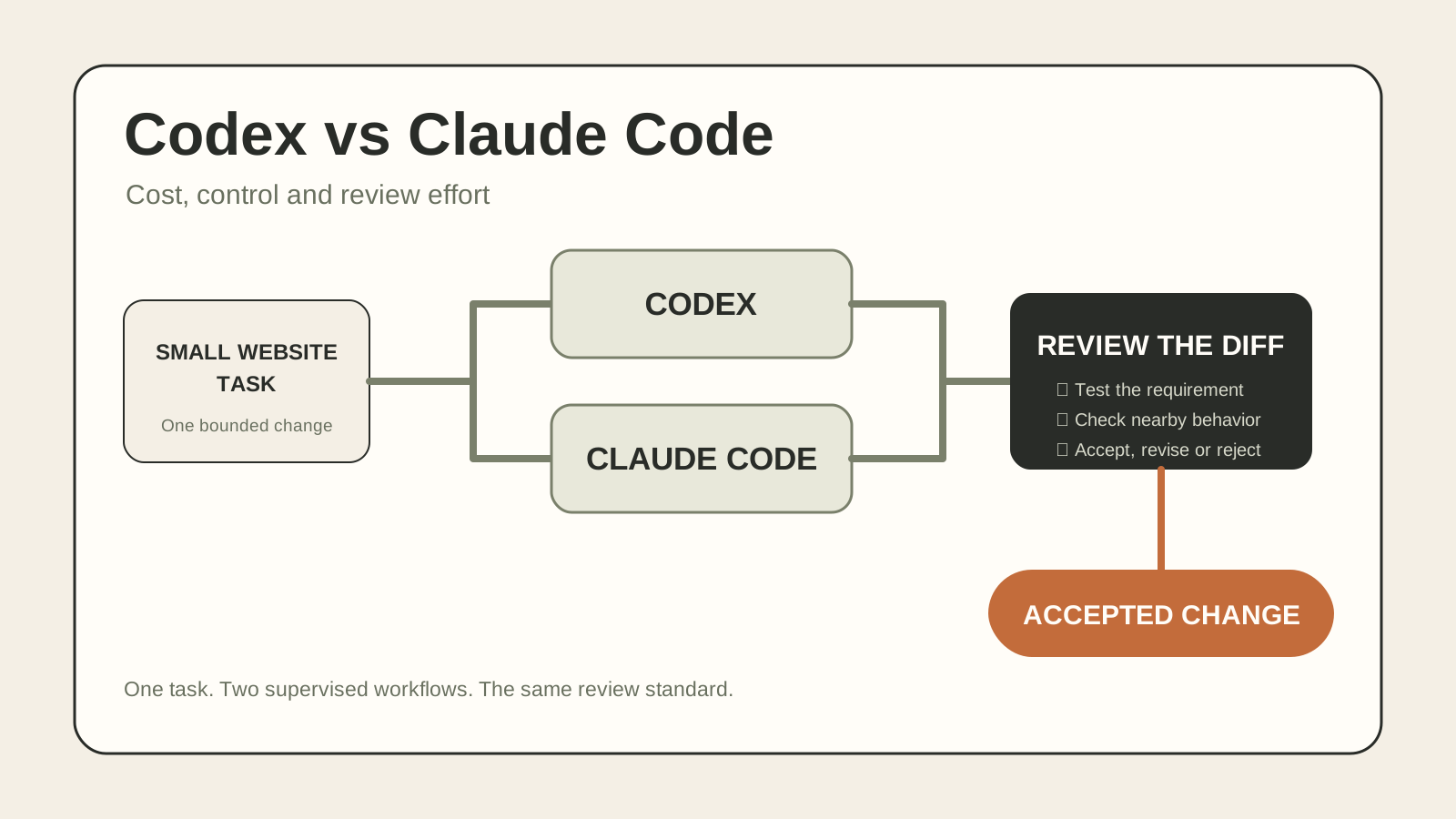
The safest useful workflow lets you see what the tool plans to change and gives you a reliable way to stop, review or reverse it.
Claude Code documents several permission modes. Manual mode asks on first use of a tool. Plan mode reads and explores without editing source files. Other modes allow more automation. Anthropic says bypass-permissions mode should be used only in an isolated environment where unintended actions cannot cause damage.
Codex also has local and cloud permission, sandbox and approval controls. In Codex cloud, the practical review point is the resulting summary and diff before opening or merging a pull request.
For a first website change, use a low-permission or planning mode where available. Work on a branch, keep the starting commit and avoid connecting production credentials. A good task can still produce a bad change; permissions limit impact while you assess it.
The real cost is the accepted change
Cost of an accepted change = incremental subscription cost + purchased usage or API charges + human review and correction time.
Incremental cost matters. If you already pay for ChatGPT Plus for other work, trying Codex may add no new subscription. The same applies to Claude Pro and Claude Code.
Usage is not a fixed number of website changes. OpenAI says Codex consumption depends on the model, task size, context, tools and whether work runs locally or in the cloud. Local messages and cloud chats share the plan allowance. Anthropic says Pro and Max subscribers receive included Claude Code usage, while separate usage credits can extend work after plan limits.
Do not compare an estimated token value from one interface with the other product’s subscription fee as if they were the same bill. Record only charges that appear on the account and time you actually measure.
Run the same three-task trial
Use a copy of a nonsensitive repository. Create one branch per tool from the same starting commit. Write success criteria before either tool begins. Do not deploy the trial changes automatically.
1. Fix a reproducible bug
Choose a bug with clear steps: the starting page and browser size, the action that triggers the problem, expected behavior, current behavior and one adjacent case that must remain unchanged. Require the tool to propose a small fix, run the relevant checks and summarize every changed file.
2. Improve a form against written criteria
Use a low-risk form in the test repository. Require associated labels, visible keyboard focus, useful invalid-input feedback, the existing success destination or test stub, and a working mobile layout at a named width. The task is complete only when the stated checks pass.
3. Change one requirement across the site
Choose a small requirement that appears in more than one place, such as changing a navigation label and its matching page heading. State which occurrences should change and which should remain untouched.
| Measure | Codex | Claude Code |
|---|---|---|
| Same starting commit | Record hash | Record hash |
| Model, plan and date | Record | Record |
| Required behavior passes | Yes / partly / no | Yes / partly / no |
| Adjacent behavior still passes | Yes / partly / no | Yes / partly / no |
| Unrequested changes | List | List |
| Human corrections | List | List |
| Review time | Measured minutes | Measured minutes |
| Extra billed usage | Account charge only | Account charge only |
| Final decision | Accept / revise / reject | Accept / revise / reject |
This is your evidence. It should not be generalized into a universal product ranking.
Review every proposed change
- Read the summary and inspect the complete diff.
- Confirm the changed files match the request.
- Run the project’s existing checks.
- Test the requested behavior and one nearby case manually.
- Check desktop and mobile layouts when the interface changed.
- Confirm no credential, generated file or unrelated dependency entered the diff.
- Keep the change on a branch until a reviewer is comfortable merging it.
Passing a test suite does not prove the page is correct. Visual behavior, content, analytics, forms and accessibility can require separate checks. If you cannot explain what changed well enough to maintain it, get a technical review before release.
When Cursor or Framer is the better starting point
Codex and Claude Code make the most sense when the website already lives in a repository and someone can review code changes.
An AI code editor such as Cursor may be easier when you want generated changes inside an editor with the surrounding code visible. A visual builder such as Framer may be a better fit when the site already uses that platform and the required change can be made safely through its interface.
These are different workflow categories, not fallback rankings. Their Domsky review links remain withheld until those pages pass the publication package’s factual-readiness gate.
Domsky recommendation by situation
| Your situation | Starting choice | Reason |
|---|---|---|
| You already pay for ChatGPT Plus | Try Codex first | Current Plus access includes Codex surfaces and connected cloud workflows. |
| You already pay for Claude Pro | Try Claude Code first | It is included in Pro and spans terminal, IDE, desktop and browser workflows. |
| You pay for neither and cloud delegation is central | Consider Codex | Its connected repository and cloud handoff match the required workflow. |
| You pay for neither and prefer editor or terminal supervision | Consider Claude Code | Its supported surfaces and permission modes match the required workflow. |
| You cannot review code or run the site locally | Use a visual workflow or technical reviewer | A second coding subscription does not solve the review problem. |
| The first tool completes the trial acceptably | Keep it | Add the second only for a repeated task the first cannot complete. |
If your main need is writing, research or files rather than repository work, compare general AI assistants before buying a coding workflow.
Common questions
Is Astra the same as Codex?
No. Astra is a model listed in current Codex usage documentation. Codex is the product and workflow through which coding tasks, repositories, tools and review are managed.
Is Claude chat the same as Claude Code?
No. They are related Anthropic products under the same account and plan structure. Claude Code is the coding workflow that can inspect repositories, edit files and run commands across supported development surfaces.
Can a nondeveloper use a coding agent?
Yes, for a bounded task if the person can run the project, define expected behavior, inspect the result and obtain help when the change is unclear. A coding agent is a poor fit when nobody can verify or maintain the output.
Should I pay for both?
Usually no. Start with the tool included in an existing subscription. Add the second only after a repeated, documented limitation makes the extra cost worthwhile.
Can either tool publish directly to production?
Both products can participate in advanced automation, but this article recommends a branch-and-review workflow for a small site. Production deployment should remain a separate, deliberate step with its own checks and authorization.
This comparison uses current OpenAI and Anthropic pricing and product documentation checked on 26 September 2026. It does not report original Domsky performance testing, defect rates or measured review time.
Prices, included models, usage allowances and supported surfaces can change. Check the provider’s current plan page and the exact account before subscribing.
Sources and evidence limits
- OpenAI: Using Codex with your ChatGPT plan
- OpenAI: ChatGPT Work and Codex
- OpenAI: Codex pricing
- OpenAI: Codex cloud
- OpenAI: Codex documentation
- OpenAI: Codex code review
- Anthropic: Claude pricing
- Anthropic: Claude Code overview
- Anthropic: Claude Code permissions
- Anthropic: Claude Code costs
- Anthropic: Claude Code sandboxing
- Cursor: Pricing
- Framer: Pricing
Continue reading